TL;DR: Choose between marble and ceramic dining tables by the exact surface, care requirements, edge construction and complete-table design, not by the material name alone.
Key takeaways
- Marble care needs to account for acid sensitivity; the Natural Stone Institute explains why acidic products can etch calcium-carbonate stone.
- A stone sealer can improve stain resistance without making the surface stain-proof, and etching is a different issue from staining.
- Ceramic does not mean indestructible: Calligaris warns against hard, sharp impacts to the edges of its glass-ceramic tops.
- Compare the whole dining table, including its support, chair space, handling requirements and route into your Mumbai home.
- Ask for the actual finish sample, construction details and care sheet before approving either material.
Is marble or ceramic the better dining-table choice?
Neither is automatically better; our recommendation is to decide which material's documented care requirements you are willing to live with. Start with the exact options in front of you, not a generic claim that natural means better or engineered means maintenance-free.
For someone who wants natural stone as the visual centre of the room, marble can remain a considered choice. For someone whose priority is a straightforward daily-care routine, a ceramic option is worth shortlisting, provided its maker confirms the properties of the selected finish and construction.
The distinction needs evidence. The Natural Stone Institute describes acid sensitivity and stone-care precautions. Calligaris describes its glass-ceramic tops as non-absorbing, while still warning about edge impacts. Those are not interchangeable promises about every tabletop on sale.
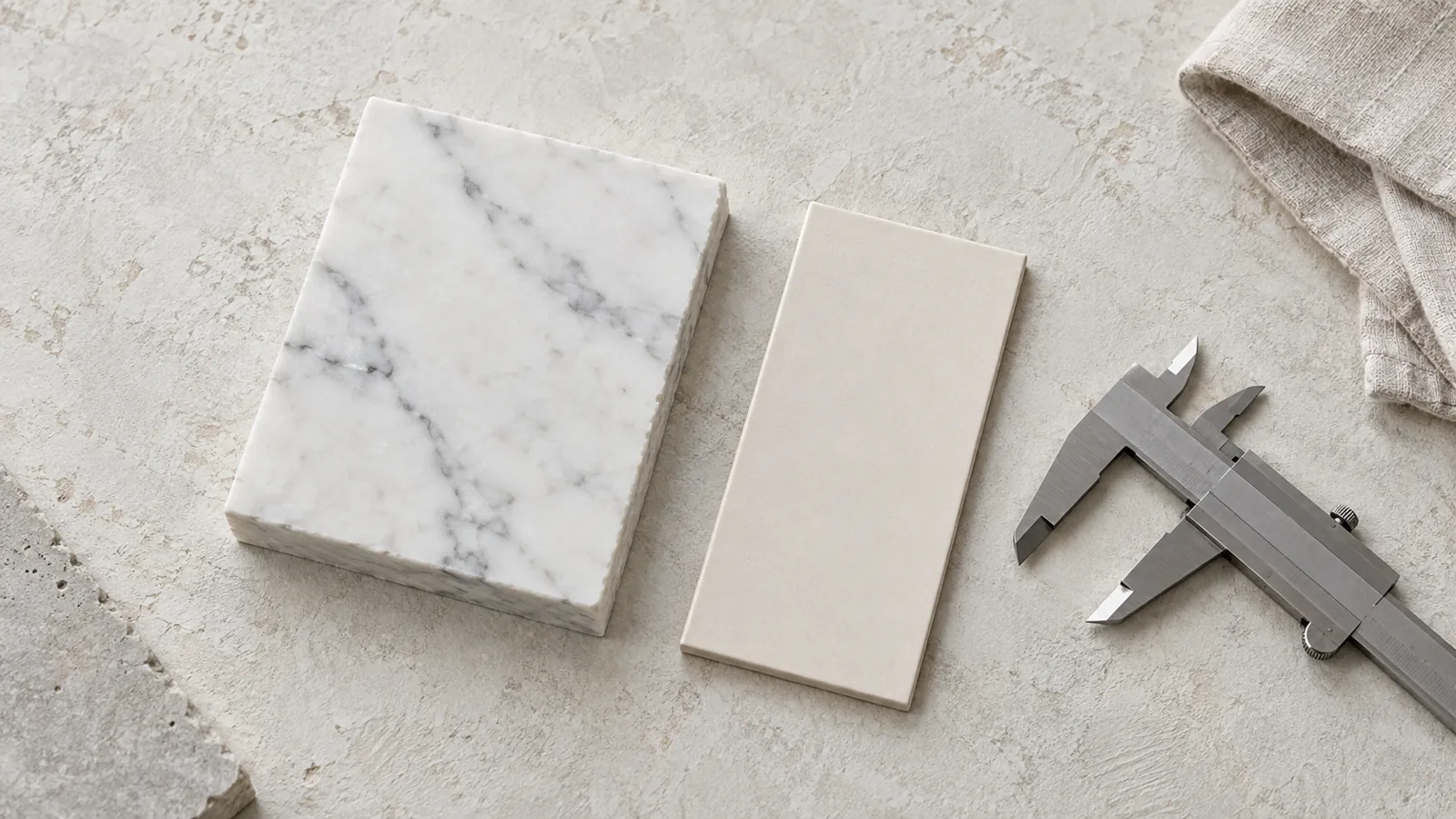
A beautiful table should suit the way you dine. It should not require every family meal to be treated as a conservation project unless you are comfortable with that responsibility.
What does marble actually ask of you?
Marble asks you to take its surface chemistry and finish seriously. The Natural Stone Institute's guidance explains that calcium carbonate is sensitive to acidic solutions and that products containing lemon or vinegar may dull or etch calcareous stone.
Etching and staining are not the same problem. The Institute notes that a substance can etch a finish without leaving a stain, or can cause both. It also explains that impregnating sealers improve resistance to staining rather than making stone stain-proof.
For your Mumbai dining brief, consider the actual routine: citrus at the table, serving dishes, glasses and who clears up afterwards. This is a household-use question, not a judgement about any particular cuisine. The Institute recommends coasters, mats or trivets and prompt attention to spills.
Ask the stone supplier what the selected finish needs, whether sealing is appropriate and what products are permitted. Do not adopt a blanket resealing timetable or a household cleaning remedy because it worked on somebody else's stone.
Is a ceramic tabletop immune to damage?
No; check the surface and the edge rather than treating ceramic as a synonym for unbreakable. In its care guidance, Calligaris warns that hard, sharp impacts to glass-ceramic edges can cause accidental breakage.
That is a useful distinction for buying: a surface's resistance to everyday spills is not the same property as an edge's response to an impact. Our recommendation is to ask for the care instructions and construction drawing for the actual product, including any supporting layers.
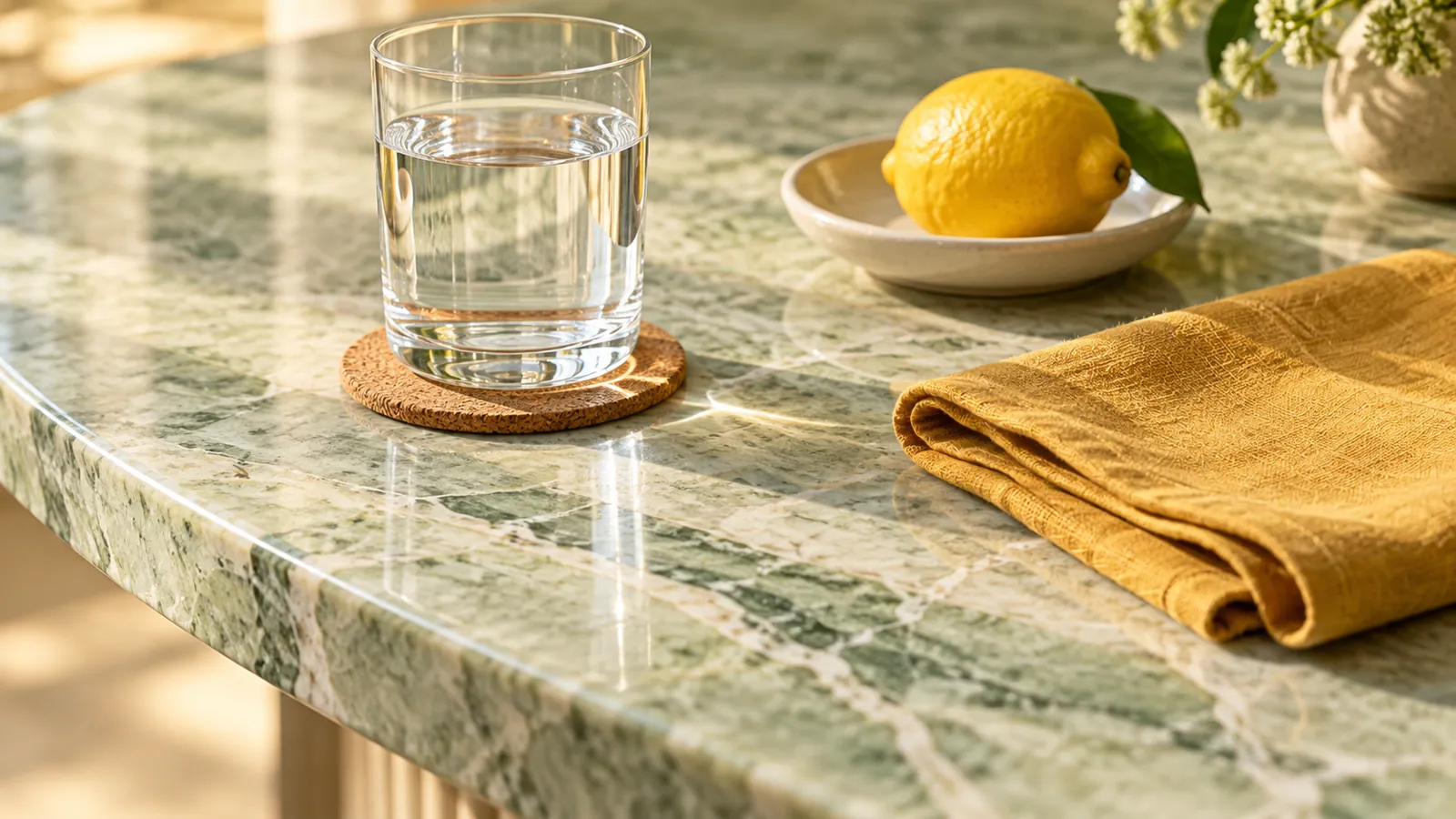
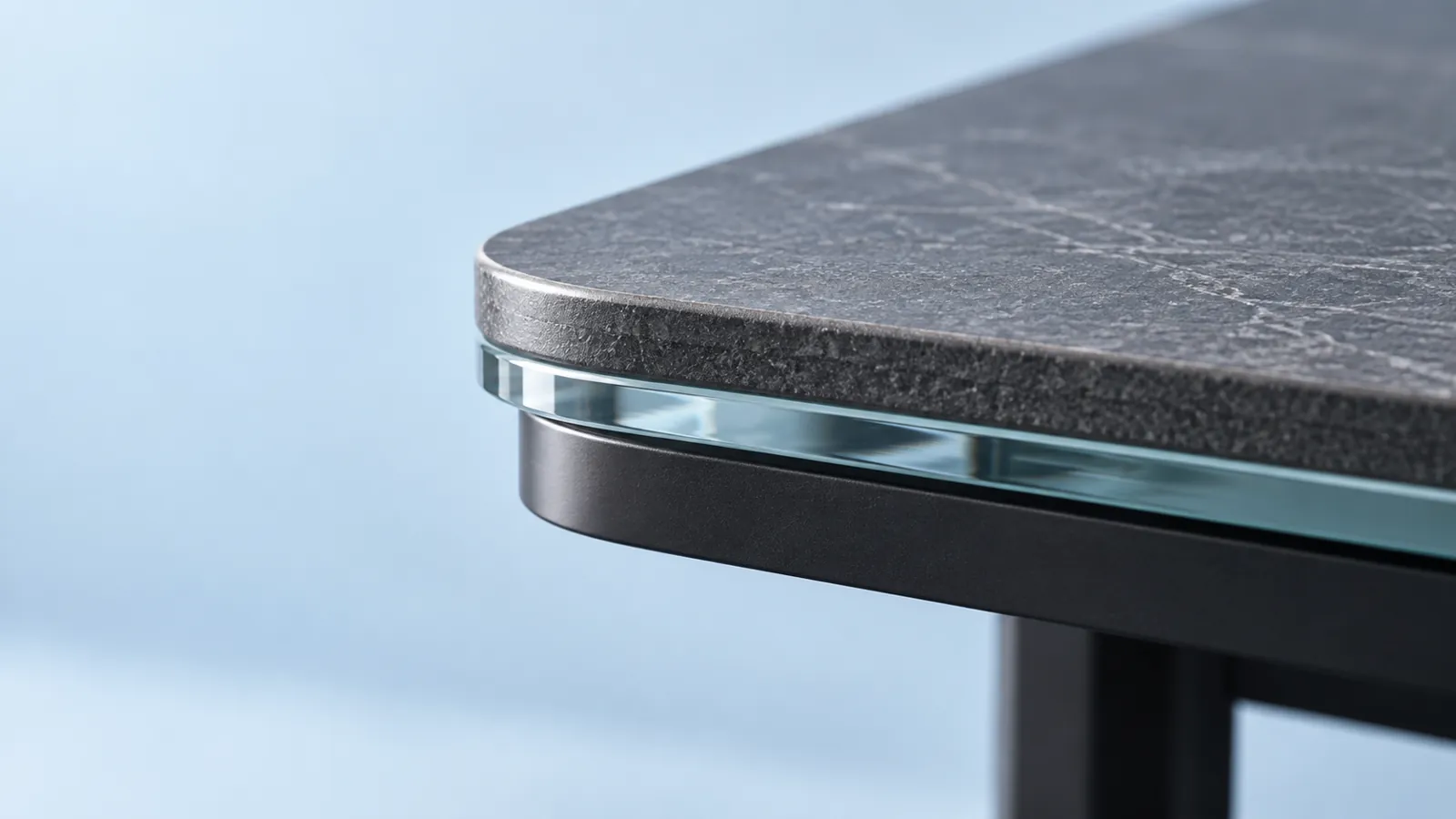
Do not assume a thin-looking top is a single slab, or that all tops described as ceramic share the same support system. Ask the supplier to identify the surface, substrate, edge treatment and attachment to the base. Those answers describe the table you would own more precisely than a category label.
If a seller uses terms such as scratch-proof or heat-proof, request the limits behind the statement. This guide does not endorse either absolute claim, and it does not recommend testing a showroom sample with a hot pan or sharp object.
What should you inspect beyond the surface?
Inspect the complete assembly because the top is only one part of the dining table. Our suggested showroom sequence is to look at the edge, examine the underside where accessible, sit with the intended chairs and ask about the support arrangement.
Check whether the base obstructs the seats you plan to use. Confirm the space needed to pull chairs out and move around the room. Do not choose the largest top that can be drawn between the walls while ignoring the people who will sit around it.
For an extending model, ask for a demonstration of the mechanism and confirm the open dimensions, handling instructions and where additional leaves are stored. Our extendable dining-table guide covers that separate decision.
For a custom piece, ask who signs off the top, base and fixings as one design. Do not assume a base selected for its silhouette is suitable for any slab you later decide to place on it.
How should Mumbai access affect the decision?
Confirm the delivery route before approving the final tabletop dimensions and construction. For an apartment, our practical checklist is the building entrance, lift, stairs, landings, apartment door and final turn into the dining area.
Ask for packed dimensions and handling requirements, not just the finished footprint. Confirm whether the top and base travel separately and who is responsible for final assembly. Building access and installation arrangements need an answer for your address, not a general reassurance that deliveries are usually fine.
An older South Mumbai building and a newer tower can raise different access questions, but neither should be judged by postcode alone. Use actual measurements and the building's requirements. Our Mumbai furniture-delivery guide sets out the access-survey approach.
No material is a shortcut around an unverified delivery route. A table that fits the room still needs to reach it.
How can you compare two quotations fairly?
Compare the complete specification and service scope, not just the price attached to marble or ceramic. Use the same intended dimensions, seating arrangement and installation destination for both options.
Ask each supplier to identify the following:
| Comparison point | Detail to confirm |
|---|---|
| Surface | Exact material and finish, with an approved sample or selection process |
| Construction | Top layers, edge profile, supporting structure and fixings |
| Daily use | Written care instructions and the limits of resistance claims |
| Installation | Handling, assembly, access responsibilities and included services |
| After-sales | Applicable terms and the process for assessing damage or defects |
Our judgement is to resolve a missing construction or care detail before declaring one quote better value. The cheaper line item may describe a different assembly, finish or delivery scope. That is a comparison problem, not evidence that either material is intrinsically better.
Limitations
This article does not test a table, rank manufacturers or establish the properties of every marble or ceramic finish. The Calligaris guidance concerns its own glass-ceramic products. Natural Stone Institute guidance is general and must be matched to the selected stone and supplier instructions.

No current price difference, weight, load capacity or ceramic availability at FCI India is asserted. Generated images illustrate design and care questions; they are not product photographs, test evidence or actual FCI workshops.
Ready to develop a dining-table brief?
Bring the room plan, preferred appearance and realistic care expectations to the discussion. FCI India's services include bespoke furniture design and material-selection consultation. Contact the Mumbai team to discuss the brief and confirm which materials, finishes and constructions are available for your project.
Sources
- Care & Cleaning of Natural Stone, Natural Stone Institute.
- Frequently Asked Questions, Calligaris. Glass-ceramic use and cleaning sections.
- Extendable Dining Table: Worth the Space?, FCI India.
- Mumbai Furniture Delivery: Will It Fit Through the Door?, FCI India.
- Bespoke Furniture Services, FCI India.
- Contact FCI India.