TL;DR: Choose sliding wardrobe doors when outward door swing is the problem, but approve the usable opening, internal depth and drawer access before ordering a custom wardrobe in Mumbai.
Key takeaways
- Sliding doors avoid an outward swing, but the opening left by overlapping panels still needs checking against the storage behind them.
- A wardrobe's external depth is not its usable hanging depth; request a section drawing showing the complete door and track system.
- Sliding hardware has model-specific limits: Hettich lists different door weights and dimensions for its systems.
- Choose the door layout and internal storage together, then test both in the agreed handover sequence.
Are sliding wardrobe doors better for a Mumbai bedroom?
Sliding wardrobe doors are a better choice when they solve a specific circulation problem without compromising access to your belongings. They are not automatically the best choice because a bedroom is in Mumbai, or because the brochure has used the word space-saving enthusiastically.
Our recommendation is to start with the room in use. Mark the bed, bedside furniture, entrance door and the place where someone stands to get dressed. Compare a hinged door's open position with the opening produced by the proposed sliding panels.
For a compact apartment, our judgement is to prioritise a usable dressing route over the largest possible uninterrupted wardrobe frontage. For a larger room, easy access to separate storage zones may matter more than avoiding a door swing. The floor plan should decide, not a generic room-size threshold.
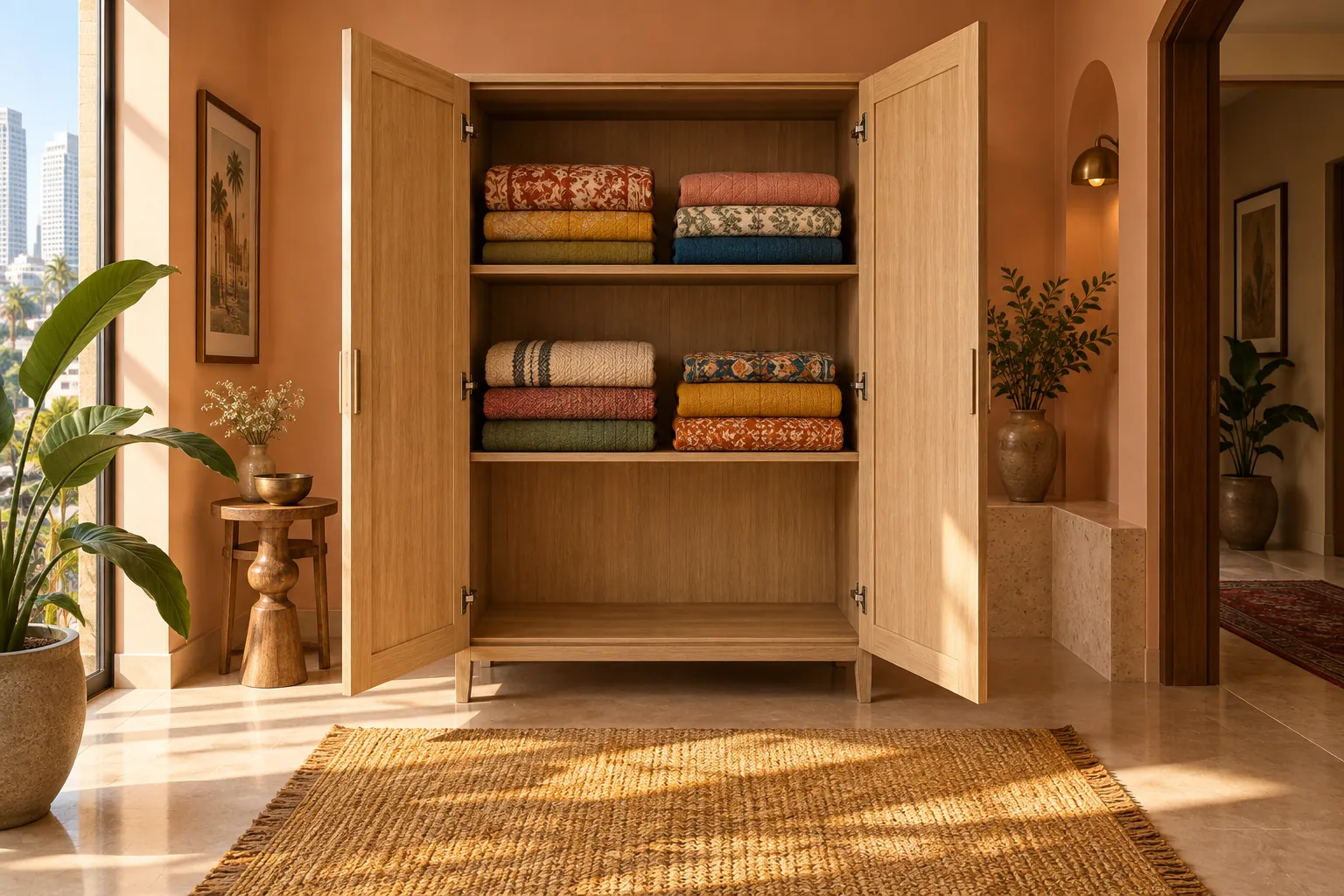
How much of a sliding wardrobe can you open?
The usable opening depends on the number of panels, their travel and their overlap, so ask for the opening width rather than assuming the whole frontage becomes accessible.
A conventional overlapping arrangement leaves some of the front behind another panel. That matters when a wide drawer, trouser rack or pull-out basket sits behind the overlap. Our design check is simple: show every internal fitting fully extended while the doors are in a permitted open position.
Do not assume all sliding systems behave identically. Hettich's TopLine XL page, for example, describes a centre door that can open to either side. This is an example of a particular system's behaviour, not a feature promised for every wardrobe.
Ask the maker to label the clear opening for each storage bay on the drawing. A beautiful closed elevation cannot answer that question. It is, rather conveniently, closed.
Do sliding doors reduce hanging space?
The full door assembly must be allowed for when calculating usable hanging depth, so an outside cabinet measurement is not enough.
Request a section drawing showing the back panel, hanging rail position, clothes, inner fittings, tracks and closed doors. Bring the hangers and bulky garments you actually use to the design discussion rather than relying on a photograph of three unusually cooperative shirts.
The key check is whether clothing and fittings remain clear of the moving panels in the agreed design. Our wardrobe depth guide explains the distinction between external dimensions and usable storage.
If a quote changes from hinged doors to sliders while retaining the same outer depth, request a revised section. Treat the change as a new layout to approve, not a cosmetic swap.
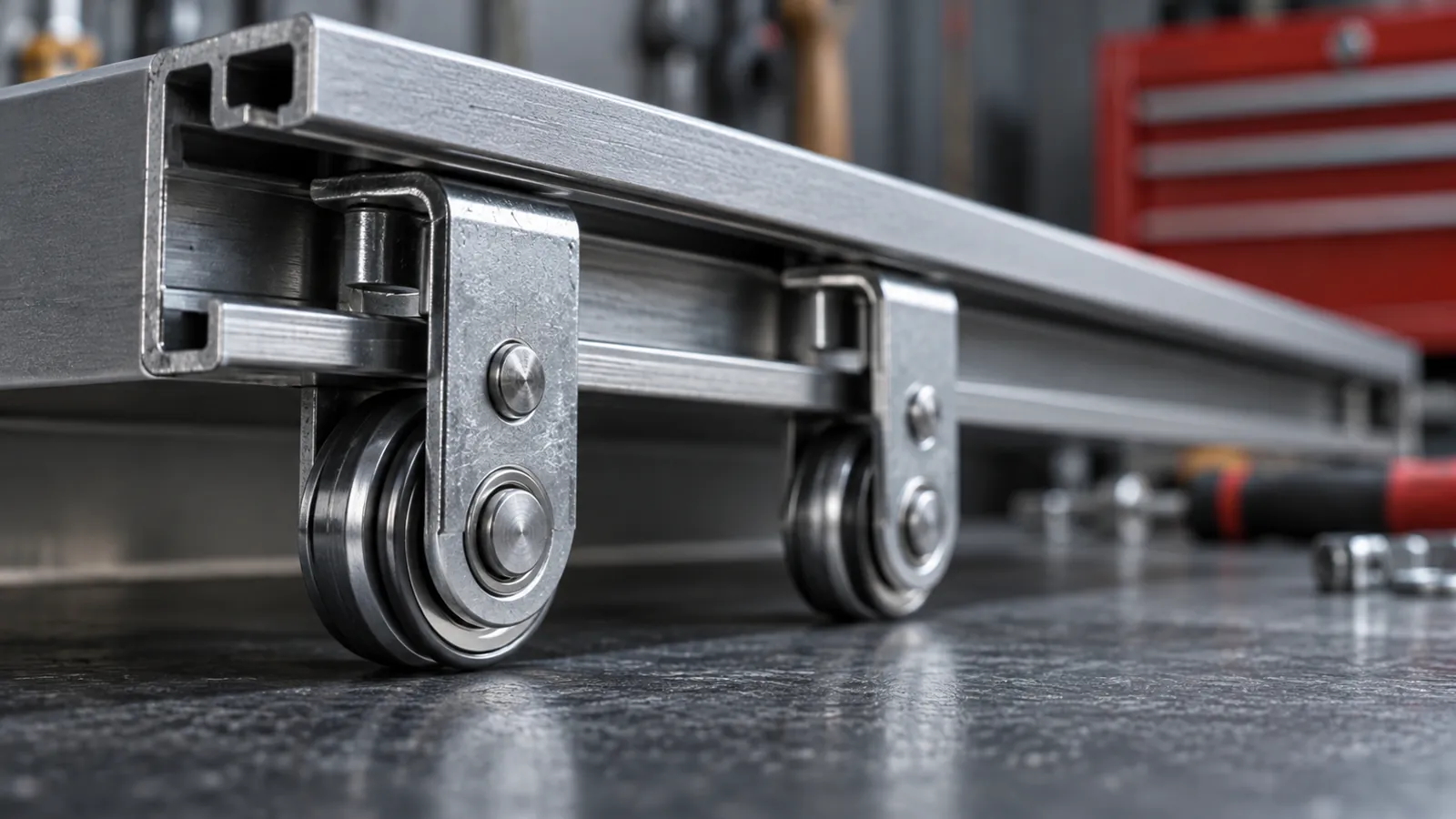
Which hardware details belong in the quotation?
The quotation should name the hardware system and match it to the proposed door construction, dimensions and weight.
Hettich's current range includes both top-running and bottom-running systems, with different published capacities and dimensional limits. The practical lesson is to request the exact model, not simply accept premium German hardware as a specification.
Ask for these details:
- Manufacturer and system reference, including the soft-closing components if specified.
- Door construction, finished thickness and the maker's weight calculation.
- Permitted door size and weight for the selected configuration.
- Track location, adjustment access and how a damaged panel could be removed.
- Written maintenance instructions and the party responsible for adjustments after installation.
Soft close describes a closing feature. It does not, by itself, establish that the entire door is correctly specified. For a hinged alternative, use our separate wardrobe hinge guide.
What should Mumbai buyers include in the site brief?
Include the actual room survey and delivery constraints, not just a wall width and a preferred finish.
Our suggested brief has three parts. First, record the proposed wardrobe position, skirting, switches, sockets and nearby furniture. Second, identify what each compartment needs to hold and how the user will reach it. Third, ask the installation team to check the building access route and the sizes of the components being delivered.
If your housing society has booking or working-hour requirements, supply the actual rules for your building. Do not treat another apartment's arrangements as a Mumbai-wide standard.
FCI India's current services page describes bespoke furniture design and manufacturing. Use that conversation to agree what is included in your own wardrobe commission; this article does not promise a particular hardware brand or configuration.
How should you check the wardrobe at handover?
Check the wardrobe in every intended operating position, not only with the doors closed.
Use the agreed drawing as the reference. Open each panel, access each storage bay and extend each internal drawer or pull-out. Ask the installer to demonstrate the specified closing behaviour and show where maintenance instructions and hardware references are recorded.
Our acceptance rule is deliberately practical: the promised storage must remain usable with the actual door system fitted. If an internal drawer is obstructed by an overlapping panel, a neat exterior does not resolve the design mismatch.
Keep any snagging list specific to the supplied design. Avoid unapproved DIY track adjustments while the installation team is resolving a problem.
Limitations
This is a commissioning framework, not an engineering specification, accessibility standard or site survey. No universal clearance, door size, price or service life is claimed. Hardware examples describe the manufacturer's published systems and do not establish what FCI India will supply for your order.
The images are generated design illustrations, not FCI projects, Hettich components or evidence of a tested installation.
What should you send before requesting a quote?
Send room photographs, a dimensioned plan, the contents you need to store and the door options you want compared. Contact FCI India to discuss a custom wardrobe brief with the usable opening and internal arrangement shown together.
Request one coordinated proposal for doors, storage and installation. That is a more useful starting point than choosing a handsome frontage and hoping the clothes sort themselves out.
Sources
- Sliding door systems, Hettich. Manufacturer information on system types and model-specific limits.
- TopLine XL, Hettich. Manufacturer description of this system's opening and adjustment features.
- Luxury furniture services, FCI India. Current first-party service scope.
- Wardrobe depth guide, FCI India. Related reading.
- Wardrobe hinges guide, FCI India. Related reading.
- Contact FCI India. Project enquiry route.