Custom furniture goes wrong long before a carpenter picks up a tool. The expensive mistakes usually begin with an incomplete brief, a sample approved under the wrong light, a drawing that ignores skirting or sockets, or a delivery route measured after the piece has been built.
For a Mumbai home, the brief also has to account for monsoon humidity, salt-laden air near the coast, compact lifts, occupied buildings and coordination with other trades. A beautiful render does not resolve any of those constraints.

This guide is a commissioning checklist for homeowners, architects and interior designers buying bespoke furniture in Mumbai. It is deliberately more demanding than a style guide: it tells you what to decide, what to record and what to inspect before approving production.

The short version: do not approve a render; approve a buildable specification

Before production starts, one controlled document set should establish:
– the room and final site dimensions;
– how every piece will be used;
– the approved construction drawing and revision number;
– named materials, finishes, hardware and upholstery;
– physical samples or a prototype where risk justifies one;
– tolerances and acceptable natural variation;
– power, lighting, ventilation and cable requirements;
– delivery access, installation sequence and protection;
– inspection, snagging, care and after-sales responsibilities.

If an item is still described as “walnut finish”, “beige fabric” or “soft-close hardware”, it is not ready. Those phrases describe an intention, not a specification.

1. Write the use brief before discussing style
Start with behaviour. Who uses the piece, how often, and what must it hold or survive?
For a dining table, record the normal and maximum number of diners, chair width, serving style and required circulation. For a sofa, discuss seat preference, household height range, pets, children and whether covers must be removable. For a study, list screens, chargers, printers, paper storage, video-call background and cable routes. A wardrobe brief should include the actual mix of long garments, folded clothes, shoes, luggage and jewellery rather than a generic rail-and-drawer layout.
Then add the aesthetic references. This order matters. If the reference image leads, the project can become an attempt to reproduce a photograph even when the proportions do not suit the room or the household.
**Decision test:** can another person read the brief and explain why each dimension and feature exists? If not, it needs another pass.
FCI India's [custom furniture service](https://fciindia.com/custom-furniture-mumbai/) covers residential pieces, built-in storage, studies, offices and commercial work. Use that page to define the scope, then use this checklist to make the scope testable.
2. Survey the finished site, not just the floor plan
Architectural drawings are the starting point; site dimensions govern the finished piece. Survey after the dimensions that affect furniture are stable, especially flooring, wall finishes, skirting, ceiling drops and service positions.
Record more than width, depth and height:
– wall, floor and ceiling deviations;
– skirting and cornice projections;
– door, window and curtain clearances;
– socket, switch, data, AC and plumbing positions;
– service panels that must remain accessible;
– sunlight and likely moisture exposure;
– lift car, staircase, corridor and doorway dimensions;
– building delivery hours and loading restrictions.
For built-ins, agree who absorbs an out-of-square wall: the carcass, a scribe panel or a site-built filler. For a large dining table or sofa, decide whether it will travel whole, in modules or be assembled in the room. “It fits on plan” is not evidence that it fits through the lift.
In Mumbai towers, a delivery-path survey can be as important as the room survey. Photograph the tight points and attach their dimensions to the approved drawing pack.
3. Turn every material description into a schedule
A useful material schedule separates what is seen from what provides structure. It should name:
– solid timber species and grade where relevant;
– veneer species, cut, leaf arrangement and substrate;
– plywood, MDF or other panel type and intended location;
– stone or solid-surface name, thickness and edge treatment;
– metal base material, finish colour and sheen;
– upholstery supplier, collection, colour code and composition;
– foam or filling specification;
– adhesive, coating or lacquer system where performance matters;
– hardware manufacturer, model, load class and finish.
This avoids two common disputes: assuming a timber-look surface is solid timber, and assuming all products with the same generic name perform identically.
Engineered panels are useful in the right construction; they should not be hidden behind vague language. If indoor-air emissions matter to your household or project standard, ask for the panel's test documentation and the standard against which it was tested. The US Environmental Protection Agency's [formaldehyde overview](https://www.epa.gov/formaldehyde/facts-about-formaldehyde) explains why composite wood products can be a relevant source. That does **not** mean every engineered board is unsafe; it means a buyer should ask for evidence rather than rely on “eco-friendly” as an undefined claim.
If responsible forestry is part of the brief, specify the claim and the documentation required. The Forest Stewardship Council explains that [chain-of-custody certification](https://fsc.org/en/chain-of-custody-certification) verifies the path of forest-based materials through the supply chain. A species name or a verbal assurance is not the same thing as a traceable certified claim.
You can review FCI India's current woods, upholstery, metals and surface treatments in its [materials and finishes library](https://fciindia.com/materials-and-finishes/), but final approval should always refer to the actual sample and schedule for your project.
4. Design for Mumbai's climate without treating one finish as magic
Wood exchanges moisture with its environment and changes dimension as moisture content changes. The USDA Forest Products Laboratory's *Wood Handbook* documents these moisture relationships and the need to account for dimensional movement in design, drying, storage and installation.
The practical implication is not “always buy teak” or “apply more lacquer”. Performance comes from a system:
– timber conditioned appropriately before manufacture;
– construction that allows expected movement rather than restraining it blindly;
– stable substrates where wide flat surfaces require them;
– balanced finishing on relevant faces and edges;
– appropriate glue, hardware and coating choices;
– protected transport and dry storage;
– sensible placement and maintenance after installation.
A sea-facing residence, an air-conditioned apartment and a sheltered inland home do not present identical exposures. Ask the maker to state the assumptions behind the construction, particularly for wide solid-wood tops, shutters, external walls and rooms that may remain closed during the monsoon.
**Limitation:** no furniture finish makes timber dimensionally inert, and no species choice compensates for wet storage, active seepage or poor site conditions.
5. Approve samples under the conditions in which they will live
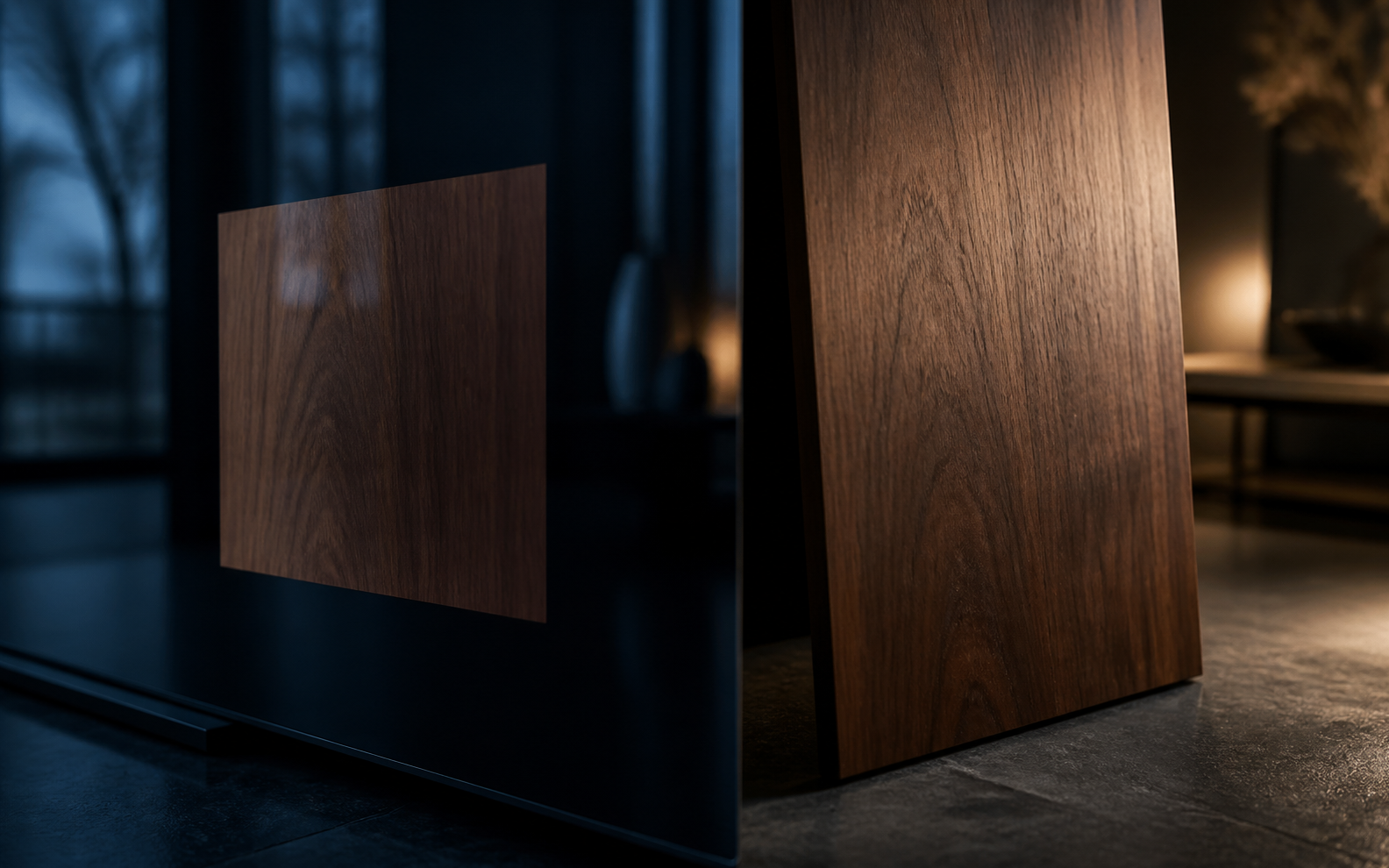
A small digital image cannot show grain sequence, texture, sheen or how a colour shifts under warm evening light. Approve a physical sample with a code and date. Keep one reference sample with the client or designer and one with the manufacturer.
For higher-risk items, increase the fidelity:
– **finish panel:** large enough to reveal grain and sheen, not a thumbnail-sized chip;
– **upholstery build-up:** fabric on the proposed foam and seam detail;
– **metal sample:** actual colour and texture, including a representative weld or corner;
– **stone slab approval:** the selected slab or mapped areas when veining matters;
– **hardware mock-up:** hinge, runner, lift or swivel tested with a realistic load;
– **prototype:** one chair, door, drawer or room module before a larger production run.
Write down what natural variation is acceptable. Timber and stone are not printed surfaces; “match the sample” should not become an impossible promise of identical grain. Conversely, natural variation should not excuse a visibly unbalanced veneer layout that could have been planned.
6. Read the shop drawing as a contract for the object
A useful shop drawing does more than show an attractive elevation. Depending on the item, check:
1. overall and critical internal dimensions;
2. sections through edges, joints, doors and drawers;
3. substrate and finished thicknesses;
4. veneer direction and grain matching;
5. hardware references and opening clearances;
6. fixing method and wall requirements;
7. cable, power, ventilation and lighting provisions;
8. removable panels for future service;
9. modular breaks and site assembly points;
10. finish codes linked to approved samples;
11. revision number, approval date and approver.
Test the drawing against real objects: the amplifier that needs airflow, the robot vacuum that must pass under a console, the suitcase intended for the top shelf, or the plug head that must pass through a cable grommet.
Never approve through a trail of contradictory chat messages. Consolidate comments, issue a revised drawing, and freeze one version for production. FCI describes detailed drawings and written approval as part of its [six-step bespoke process](https://fciindia.com/our-process/). For professional teams, its [architect partnership workflow](https://fciindia.com/furniture-for-architects/) also sets out sampling, shop drawings, manufacturing updates and site coordination.
7. Separate the quotation from the scope assumptions
The price is only comparable when the scope is comparable. Ask the quotation to identify:
– exact pieces and quantities;
– inclusions and exclusions;
– materials, hardware and finish level;
– sampling, design and prototype allowances;
– taxes, transport and installation treatment;
– dependencies on site readiness or other contractors;
– payment milestones tied to real stages;
– estimated programme and approval deadlines;
– change-control method after sign-off;
– warranty, maintenance and repair terms.
Do not use this checklist to force an early fixed number before the design is defined. Use it to expose what the number assumes. A low quotation with unnamed hardware, unresolved access and no sample process may simply defer cost and argument until later.
FCI's own published process says timelines vary by scope and gives examples, but your signed project programme should govern your commission. This article deliberately makes no universal price or delivery promise.
8. Plan production checks around irreversible decisions
Inspecting only at the end is too late for hidden construction. Agree evidence points before work starts. A sensible sequence can include:
– incoming material and veneer selection;
– carcass or frame before upholstery and finish;
– dry assembly and mechanism test;
– finish approval after the first representative piece;
– final inspection against drawings and samples;
– packing condition before dispatch.
The purpose is not to micromanage craftspeople. It is to catch expensive divergence before the next layer conceals it. One labelled photo set per checkpoint is more useful than a stream of unreferenced workshop pictures.
For repeated pieces—dining chairs, hotel headboards or office workstations—approve a first-off item before the remaining batch. Check comfort and function, not only appearance.
9. Treat delivery and installation as part of the design
Confirm the site is ready: access clear, wet work complete, dust controlled, power available and finished surfaces protected. Agree which team moves existing furniture and who removes packaging.
For installation, prepare a room-by-room list and sequence. Large pieces may need to arrive before fragile accessories; wall-mounted items need verified substrates and concealed-service checks. Built-ins should not block electrical or plumbing access without an agreed removable panel.
At handover, inspect:
– level, alignment and door gaps;
– stability and fixing;
– drawer, hinge, lock and soft-close operation;
– upholstery tension, seams and pattern alignment;
– finish consistency against the retained sample;
– scratches, chips, stains and site damage;
– lights, sockets, chargers and cable routes;
– all keys, remotes, spare parts and care documents.
Record snags by room, item code, photograph, owner and target resolution date. “Pending polishing” is not a usable snag; “DB-02, left front edge, 30 mm lacquer abrasion, repair method to be approved” is.
A one-page approval gate
Do not release production until every answer below is **yes** or formally marked not applicable:
– Is the use brief complete?
– Has the final site and delivery route been measured?
– Does every material and hardware item have an unambiguous reference?
– Are physical samples labelled and retained?
– Does the latest shop drawing resolve services, clearances and assembly?
– Are climate and moisture assumptions explicit?
– Are scope, exclusions, milestones and change control documented?
– Are production evidence points agreed?
– Are installation prerequisites and responsibilities assigned?
– Is the handover and snagging method defined?
A “no” does not automatically stop the entire project. It identifies the risk that somebody must consciously own. That is the real value of the checklist.
When bespoke is the wrong answer
Custom manufacture is valuable when dimensions, material expression, storage logic or architectural integration matter. It is not automatically superior.
Choose a ready-made piece when it already fits, can be inspected immediately, needs to move between homes, or when speed and easy replacement matter more than exact integration. Use a hybrid approach when a standard chair, mechanism or desk base can be paired with custom storage or a made-to-measure top.
The mature buying decision is not “bespoke everywhere”. It is to reserve bespoke work for places where control over fit, function and finish creates enough value to justify the extra decisions.
Commission with fewer assumptions
The best custom furniture feels effortless when it arrives because the difficult decisions were made before production. Define use, survey the site, specify the hidden construction, approve real samples, freeze controlled drawings and inspect at irreversible stages.
If you have a Mumbai residence or professional project ready for that level of definition, [book a consultation with FCI India](https://fciindia.com/contact-us/) and bring this checklist to the first meeting.
Architects and interior designers can also review FCI's [trade workflow and material resources](https://fciindia.com/furniture-for-architects/) before sharing a drawing package.
Frequently asked questions
What should I take to a custom furniture consultation?
Take a dimensioned plan if available, photographs of the room and access route, reference images, a list of users and functions, a realistic programme, and a budget range. Treat inspiration images as direction, not a specification.
Should I approve custom furniture from a 3D render?
No. A render helps communicate form, but approval should also cover dimensioned shop drawings, material and finish samples, hardware, construction assumptions and installation details.
Is solid wood always better than plywood or MDF?
No. Each material has appropriate uses. Solid timber offers particular tactile and repair qualities but moves with moisture. Quality plywood and other engineered products can offer useful stability. Ask what is used where, why, and what evidence supports any emission or sustainability claim.
When should the final site measurement happen?
After the finishes and service positions that affect the furniture are stable, but early enough to revise drawings before production. Built-ins and pieces with tight access need particular care.
How can I compare two bespoke furniture quotations?
Normalise the scope first: quantities, construction, materials, finish system, hardware, sampling, design work, transport, installation, taxes, programme, warranty and exclusions. The totals are not comparable if those assumptions differ.
Sources and further reading
– [FCI India: Custom Furniture Mumbai](https://fciindia.com/custom-furniture-mumbai/) — current service scope and manufacturing claims.
– [FCI India: Our Process](https://fciindia.com/our-process/) — consultation, sampling, drawings, manufacturing, inspection and installation workflow.
– [FCI India: Materials and Finishes](https://fciindia.com/materials-and-finishes/) — current material library and Mumbai-climate positioning.
– [FCI India: Furniture for Architects](https://fciindia.com/furniture-for-architects/) — professional sampling, shop-drawing and site-coordination workflow.
– [USDA Forest Products Laboratory, *Wood Handbook*](https://www.fpl.fs.usda.gov/documnts/fplgtr/fpl_gtr190.pdf) — wood–moisture relationships, dimensional change, drying and moisture control.
– [Forest Stewardship Council: Chain of Custody Certification](https://fsc.org/en/chain-of-custody-certification) — what traceability behind FSC claims entails.
– [US EPA: Facts About Formaldehyde](https://www.epa.gov/formaldehyde/facts-about-formaldehyde) — formaldehyde sources and composite-wood context.
Sources
- https://fciindia.com/custom-furniture-mumbai/
- https://fciindia.com/our-process/
- https://fciindia.com/materials-and-finishes/
- https://fciindia.com/furniture-for-architects/
- https://www.fpl.fs.usda.gov/documnts/fplgtr/fpl_gtr190.pdf
- https://fsc.org/en/chain-of-custody-certification
- https://www.epa.gov/formaldehyde/facts-about-formaldehyde
- https://html.duckduckgo.com/html/?q=custom+furniture+Mumbai+checklist